Internet Income
Step 4: Drive Traffic
Internet Income
Step 4: Drive Traffic
Step 4: Drive Traffic
Basic Concepts
At the end of the day…online success comes down to traffic, which means reaching an audience and guiding them in the direction of your work. You can have the best products in the world and the most advanced website and a compelling free gift offer. You can create webinars and email sequences to guide people down your sales path (funnel) – but where are all those people going to come from?
Where do you get traffic at a reasonable cost?
Considering all the noise and confusion in the online marketing world, you may be pleasantly surprised to know that there are exactly FOUR ways to drive traffic online…
Each of these four types of media (traffic) has Pros and Cons, which are provided in our online version of this ebook (see icons to the right). Your job is to choose the perfect mixture of the four types of media for your unique situation, which means evaluating…
Step 4: Drive Traffic
Pros & Cons

Pros
Paid media has the advantage of being plentiful. If you can find your own successful metrics (the ROI for your particular offers) then you can scale up and up and up. It’s also a great way to get new prospects from outside your normal pool of contacts and partners. While paid media leads are often considered to be “cold” leads, the proper sales funnel can warm them up.
Cons
Paid media is risky. You have to invest a chunk of money just to find your successful metrics — if you ever find them. And most paid media does not result in massive profits. Rather, you spend $25,000 per month on PPC ads in order to make $30,000 per month in revenue. While that’s something you can do over and over every month, netting $5k each time (and who wouldn’t want that?), it’s not the windfall you might be thinking you’ll get from a successful media campaign.
Paid media also brings the coldest leads to you — so you need a special funnel that is specifically designed to engage quickly and warm up your audience fast!

Pros
Performance Media is the least risky of all the media types, because you don’t pay for the promotion until you know you’ve made a sale. You pay a commission on each sale, so there’s no risk, provided you can afford the commission you’re paying.
Cons
To make Performance Media (affiliate programs) work, you must have strong affiliates and that requires hiring professional affiliate managers to care for them. You must also constantly give your affiliates new offers to promote and new incentives to make money promoting them.
Generally speaking, you end up paying more in commissions for performance media than you would on paid media, assuming you can find your successful paid media metrics. In other words, performance media metrics are more expensive than other types of media. You pay for the low-risk situation.
Another problem with performance media is that you have almost no control over who promotes for you. Affiliates are not obligated to promote because you’re not paying them to promote. So it’s up to them how, when, where and how often they promote. You do have control over whom they promote to by way of your affiliate terms and conditions, which should be created to prohibit certain kinds of promotions.

Pros
Exchange media is one of the most DIRECT forms of marketing because it usually involves an exchange of email promotions. That is, two parties agree to email their audience about the other. This results in a high engagement rate because it’s direct contact with a customer list from a trusted source (the source of the list).
Exchange media provides the warmest leads you can get because the person or organization promoting you to their mailing list is directly recommending you and your work — thus loaning you the trust that they’ve earned from their audience. You almost can’t buy that kind of recommendation.
Finally, exchange media is the cheapest form of promotion because instead of paying money for the promotion, you agree to promote your partner in return. The cost is only a fraction of what normal paid promotions would cost.
Cons
There are a lot of reasons why exchange media partnerships won’t come together, making it very difficult to engage in this form of promotion:
Too many JV commitments: there are only so many promotions you can send to your mailing list — and each time you send, your list shrinks just a bit. You end up taking two steps forward and one step backward on each JV.
Some people have a bad impression of Joint Venture exchanges – -thinking that they will have to promote all sorts of things they don’t like or don’t want to promote. This is not true, but often difficult to convince others of.

Pros
Organic media is among the least risky forms of marketing because it often just involves your own sweat and hard work.
Many people already use social media and love doing it, so learning the tricks of social media marketing is an easy way to increase their marketing footprint with something they are already doing.
Some forms of organic marketing, such as article marketing, last a long time — much longer than other forms of media. A good article can pick up traffic for years.
Social media, the main form of organic media, accumulates over time, so you don’t have to do everything all at once. Just be consistent.
Cons
Organic media is among the most passive forms of marketing around. You have no control over who sees you and how quickly they will respond…if they respond at all. You put content out onto the various sites and portals and hope people will see it and respond.
Social media can be a black hole of wasted time and energy…taking more of your time than it should.
Social media is quickly becoming a science that requires an organized, professional approach to work well. That means it’s quickly becoming an expensive form of marketing.
If you don’t coordinate your social media efforts with your keyword marketing, your article marketing, and your other forms of outreach, you may not get results.
There are so many forms of organic media (social media, article marketing, blogging, video channels, on-site SEO, external SEO, etc.) that it can be confusing and overwhelming.
Step 4: Drive Traffic
Helpful Resources

Email Exchange Network
Accelerate your list building efforts using the Joint Venture CO-OP. It’s a network of like-minded entrepreneurs who build their business by cross promotions and joint ventures. And it’s all accelerated by the CO-OP’s unique approach. It’s an easy and inexpensive way to start building your list and your business.

Self-Evaluation and Strategy
Find out where you stand with your marketing platform (A-List through D-List) and what you need to move to the next level. Our simple inventory and evaluation session will give you clarity and priorities for your next-level movement. Plus, you’ll get recommendations for where to get the best services to get you there!
Start your inventory evaluation today: just 4 pages (takes about 15 minutes)…

Webinar
This webinar tells it all. The most important thing to know about online marketing and why most courses are destined to fail. It’s an information-packed webinar that you shouldn’t miss!

Conscious Media Relations is a publicity firm specializing in the human potential market — and helps authors get booked on radio shows and speaking engagements. They have a unique pricing strategy that makes them a great choice for anyone starting out or advanced marketers alike.
Step 4: Drive Traffic
Exercises

Write four headings on a piece of paper (horizontally): Paid, Performance, Exchange, Organic.
Now write the services, strategies and ideas you have for each of these under the headings. For example, under Oganic, you might list “my blog” and “radio shows”.
Place percentages next to each of the four to indicate which portion of your entire marketing campaign each category represents. The total should, of course, equal 100%.
Get yourself an inventory from the Helpful Resources section of this page and use it to guide you in the above process.
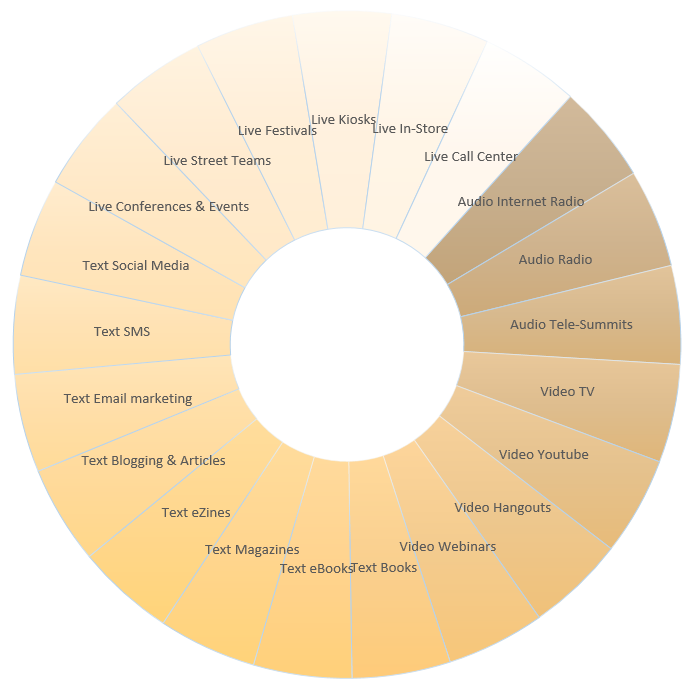
Download the 360 Marketing Wheel diagram using the link below and study the different sections and strategies. Are there any that you don’t understand? Any that you want to use in your overall plan? Add some of these to the first exercise you did above.